Tug

People who know me in real life (as opposed to those who merely choose to follow the infamous internet personality and all-round shining wit that writes this stuff) may have seen this image over the weekend.

0

Whereby we attended a sandy Strandlopery place on Struisbaai beach after a walk along the shore (strandloping), and enjoyed some of their Moar Koffie.

But, because I’m sad like that, I found myself wondering if the decorative lifebelt was just that (decorative, I mean; I know it was a lifebelt) or whether there was actually a boat called the F.T. Bates.

Those beagle-eyed readers who have glanced slightly further down the page may already have guessed the answer to this one.

It’s a yes.

ftbatesAnd look there on the front of the forecastle. Lifebelts.
The J.T Bates was a deep-water salvage tug built on the Clyde in 1950 and operating in and around Cape Town from 1950 until 1980. From there, she moved to Durban for a few years, but was scrapped there in 1983. The lifeboat from the tug (seen next to the funnel above) is now on display in the Port Natal Maritime Museum in Durban.

A pencil sketch to illustrate what the F.T. Bates might have looked like if it was hypothetically being repaired in Port Elizabeth in the late 1970s

The tug was named for the F.T. Bates who was “the senior member of the Union Government of South Africa. (Railways & Harbour Administration)  Railway Board” in the mid to late 1940s.

One of the major moments in the history of the J.T. Bates was in the S.S. Seafarer wreck:

As the engine-room began to flood the engines were shut down for fear of an explosion and Capt Branch realised that the ship was in grave danger. Every wave that broke over the SA.Seafarer pushed her further and further onto the reef. Hurriedly, but calmly, the passengers and crew gathered in the lounge while they awaited instructions from the master. By this time it was obvious that there was no chance of saving the vessel. The first message from the ship was one of urgency: “Please take off passengers and crew as soon as possible”. Rescue operations from the shore were immediately set into motion. The tugs F.T. Bates and C.G. White left Duncan Dock and manoeuvred into position outside the breakers off Green Point in order to render whatever assistance possible.

Obviously, there was very little (actually nothing) that the tugs could do on that night. In fact, it’s 33 years since the F.T. Bates has done anything.

But its name lives on through a lifebelt on a beach bar in Struisbaai.

Second

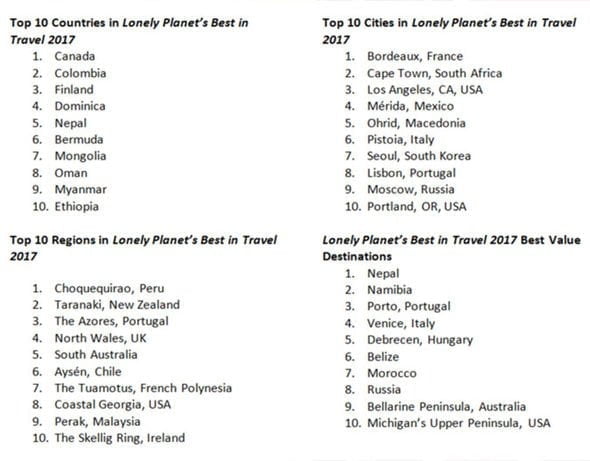
Lonely Planet’s Best in Travel 2017 list has been revealed and Cape Town makes second place in the Best City category:

…thanks to new cultural attractions such as the forthcoming Zeitz Museum of Contemporary Art Africa.

after the title was taken by a French city with much improved rail links:

Lonely Planet highlighted the French city’s new wine-themed visitor experience, the Cité du Vin, its “gastronomic revolution” and forthcoming high-speed rail connectivity as reasons it had been bestowed the title.

Hmm. Sounds like a Bordeaux-line decision.

I’m so sorry.

Other cities you should visit next year apparently include Los Angeles, Lisbon and Moscow. The regions category is let down slightly by the somewhat bizarre inclusion of “North Wales”, while the countries list is a complete joke in that it comprehensively fails to contain either Norway or South Africa:

lonely-planet-best-in-travel-2017-full-list-695598

Johannesburg doesn’t get mentioned at all.
Not in any of the “good” lists, anyway.

Level 3 Water Restrictions For Cape Town

Yep. “Just” 11 months after putting the Level 2 water restrictions in place, and with a disappointingly dry winter behind us, the City’s Mayco has approved the implementation of Level 3 restrictions from 1st November 2016. That’s because you and I haven’t saved enough water this year.
Victim-blaming hat on:

Cape Town residents as a whole did not achieve the consistent 10% reduction in water use that was mandated from 1 January 2016. If we continue to use water as we did on Level 2 restrictions over the coming summer months, the dams are at risk of falling to 15% by the end of the summer period. Following on, if we experience poor rainfall next rainy season, we could find our dams at approximately 50% this time next year.

The dam levels have slipped slightly again this week – their second successive weekly fall, and although it’s not by much, it’s still not by much the wrong way. Unless something dramatic happens, our “high” at the end of winter will have been a worrying 62.5%.

Chez 6000, we’ve already been washing with a bucket on the shower floor to collect the “spare” grey water, which then goes on the garden each morning. But apparently it’s simply not been enough.
“SO MANY BUCKETS THOUGH!!!!” he wailed.

In basic terms, what these means is that the more water you use, the more you will pay – at higher tariffs too, but if you can reduce your usage by 20%, you should pay no more than you are already paying (but for less water, obviously).
Oh – and there are some other really important additional new rules too:

 – Watering/irrigation (with drinking water from municipal supply) of gardens, lawns, flower beds and other plants, vegetable gardens, sports fields, parks and other open spaces is allowed only if using a bucket or watering container. No use of hosepipes or automatic sprinkler systems is allowed.

– Cars and boats may only be washed with water from buckets.

– Manual topping up of swimming pools is allowed only if pools are fitted with a pool cover. No automatic top-up systems are allowed.

– No portable play pools are permitted to be used.

What remains to be seen is whether any of this will be policed or whether the city will simply rely on those higher bills to deter excessive water usage. Since that approach evidently didn’t work on the Level 2 restrictions, I wonder if they will actually be doing something about people not obeying the rules this summer?

Bad driver checklist

Cape Town drivers are, apparently, terrible. And apparently Cape Town drivers aren’t just terrible, they’re more terrible than drivers in other parts of South Africa. I might well be persuaded to go along with this sweeping generalisation, but then I don’t do a huge amount of driving elsewhere in South Africa, so I don’t really have a lot to compare them with.

As with all things that are good and/or bad, there are degrees of goodity or baditude. The best way to find out whether someone is a terrible driver is probably just to observe them driving terribly, but if you don’t have time for that – or if you prefer to be forewarned – then I have noted that there are a few telltale signs that should alert you that a Cape Town driver is going to be particularly terrible.

Here is a list of those signs. It’s not in any particular order. The risk is cumulative, so the more of these boxes that any driver ticks, the greater the danger to those around them.

1. The vehicle has a CF number plate. It used to be that you had to be wary of CY number plates (and with good reason), but Kuils River is the new Bellville. In number plate terms, at least. I suppose the dodgy strip joints will soon follow.
As I’ve mentioned before, bad driving is evidently spreading slowly eastwards. Plettenberg Bay is going to be a disaster in about 2052. You’ve been warned.

2. The SSSS concern. As in, the vehicle is sporting a Southern Suburbs School Sticker. Specifically from a boys school. Like “Proud Rondebosch Family”, “Brothers In An Endless Chain” (that’s Wynberg Boys’ current sickeningly simpering ideology) or “SACS Pride”.
These stickers are worn with honour, but honour does not come for free. It comes at the hefty price of a 50% decrease in your (possibly already meagre) driving ability.

3. Hondas. (Had One Never Did Again; History Of No Dramatic Acceleration).
Yes, BMW and Audi drivers drive arrogantly, dangerously and stupidly fast, but that’s to be expected, because their drivers are cocks. Honda drivers (especially those driving the Jazz), drive obliviously, and that’s actually far more terrifying. It’s almost as if they don’t recognise that there’s likely to be any other road users out there.
Take your horrid little Brio out to the middle of the Karoo and you might be right. Drive it down Sea Point Main Road on a Saturday morning and – I assure you – you’ll be wrong (to the detriment of all around you).

4. GPS in the middle of the windscreen. Do people in other cities really do this too? Yes, you need to know where you’re going (although we have the Mountain for that), and yes, you need us all to see that you have a GPS, but putting it directly in your field of view when you are (allegedly) in control of 1000+kgs of motor vehicle isn’t the best idea you’ve ever had. It’s like driving with one eye closed (I’d presume, anyway), and that makes the road infinitely more dangerous for those unfortunate enough to be around you.

5. Any 4 wheel drive Toyota. Do you drive a Run-X or a Yaris? If so, you pose no additional risk to anyone else on the road. Are you in a Land Cruiser? Yes? Well, you’re a massive liability.
Sorry to do this, but the major culprits in (already dangerous) Land Cruisers have two add-on risk factors: i) 30- and 40-something year old mothers, and ii) those pisspoor stick figure family things on the back windscreen.
Don’t misunderstand me here: 30- and 40-something year old mothers in any other vehicle are fine, and stick figure family things on the back windscreen are… well… they’re utterly dismal. But alone (or even as a pair) these factors don’t come along with any additional deterioration in driving prowess. Stick either of them – or, heavens preserve us, both – onto or into a big Chelsea Tractor though, and you increase the danger to those around you to frankly near incomprehensible levels.

6. Golden Arrow Buses. In Durban, bus drivers have used their vehicles to block intersections as a form of protest. In Cape Town, they do it because there’s a vowel in the day. The only thing scarier than an errant driver racing through Observatory in a Honda Jazz is an errant driver racing through Observatory in a 15-tonne Golden Arrow Bus.
It used to be that taxi drivers were the public transport scourge of the roads. No longer. It’s not because the taxi drivers have got any better. They’re simply been overtaken (often literally and illegally) by a filthy, 12 metre long, 1980s accident waiting to happen.

7. Cyclists. Obviously not drivers per se, but disproportionately dangerous on the roads. We’ve been through the issues surrounding cyclists more than once, but it seems to make sense to warn you to steer well clear of them and their entirely predictable unpredictability. The only thing you can guarantee about them is that they’ll happily race through red traffic lights and then blame cars for everything. This is a great example of tarring everyone with the same brush: in actual fact, cyclists should just blame Hondas for everything.

8. Cars with a dreamcatcher hanging from the rear view mirror. Technically, individuals who have a dreamcatcher hanging from their rear view mirror don’t know actually what a rear view mirror is. They think it’s a dreamcatcher hanger. They have no idea that it has any other purpose. That’s one reason that they’re more risky to be around on the road. The second reason that individuals who possess dreamcatchers are dangerous is that they are usually hippies who are concentrating more on stuff like world peace and veganism rather than actually driving safely. For some reason, these people feel that they are allowed to appropriate First Nation culture with absolutely no penalty. Aside from the crippling inability to drive.

Did I miss anything?
Stay safe out there.
And please share for awareness.

Quota pelicans

I’ve been here a long time now. Almost 30% of my life. But I still get a childish kind of excitement when I spot stuff that, as a child, I would only have seen in a zoo. And by this, I mean wild stuff. Not stuff in a zoo. Because you’d expect to see that in a zoo anyway. No, I’m talking about baboons, penguins, whales (no, I’ve never seen a whale in a zoo), flamingos, ostriches, snakes, mongeeses, and yes, pelicans.

28349707962_299f97960f_h

This isn’t my photo. I was emailed it. Sadly, I’m fairly sure that it isn’t the photo of the person that emailed me either. So credit to the Unknown Photographer. Nice work.

Pelicans, for the record, are large. Big, chunky birds which do a lot of soaring. You can see them in Cape Town on the in-this-case-ever-so-slightly-misnamed Flamingo Vlei in (Uns)Table View and, if you’re lucky on the Black River between Obs and the M5. The locals are Great White Pelicans (Pelecanus onocrotalus) (and nothing to do with the sharks) whereas the ones above with their pink beaks and thin black line under their wings are, I think, Australian Pelicans (Pelecanus conspicillatus).

And of course, when speaking of pelicans, one should always quote Dixon Lanier Merritt:

A wonderful bird is the Pelican.
His beak can hold more than his belly can.
He can hold in his beak
Enough food for a week!
But I’ll be darned if I know how the hellican?

Yep. Big beaks. And those Aussies above have the biggest of all.

The record-sized bill was 50cm (20″) long.

Half a metre of beak. And that’s mainly keratin, just like your hair and nails, and just like a rhino’s horn.

Yikes. No-one tell the poachers…