I quite like long exposure photographs. And not just from other people. I’ve had a go at a few long exposure photographs myself.
I think my record length is 4 hours. And it worked out quite well.
But those 240 minutes pale into insignificance when you learn about what Jonathon Keats, an experimental philosopher at the University of Arizona, is doing.
His is longer than mine (stop it). His is going to be 1000 years long.
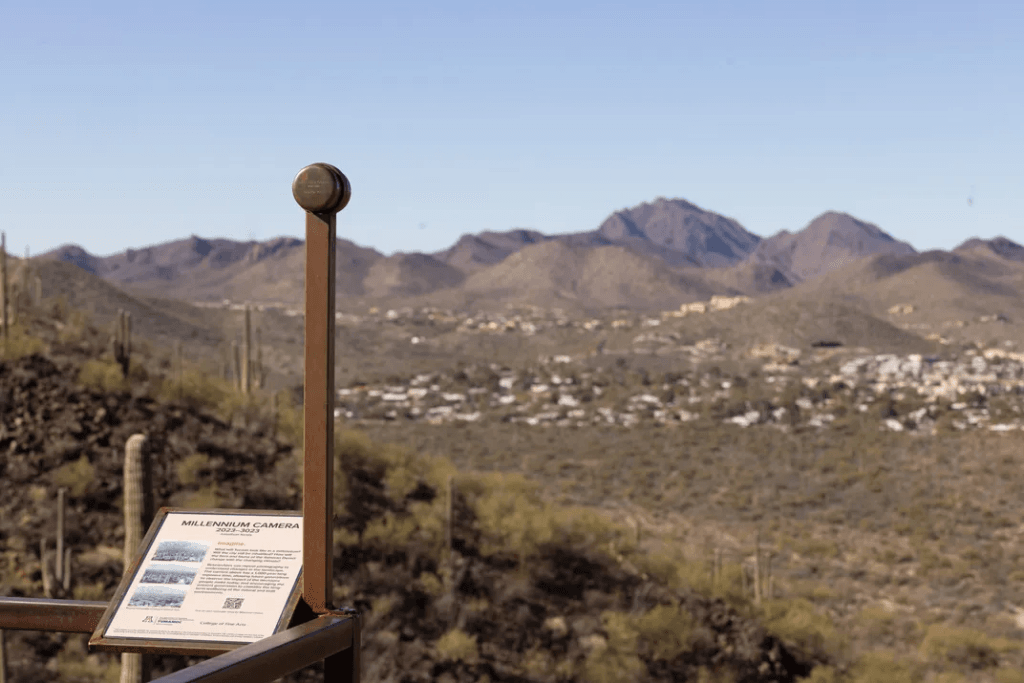
His creation is simple: A small copper cylinder with a pin-sized hole sits atop a steel pole. To ensure the device survives the ravages of time, the tiny opening was pierced through a thin layer of 24-karat gold. Over the next 1,000 years, sunlight that enters the contraption will slowly fade a light-sensitive surface covered in an oil paint pigment called rose madder, resulting in an extremely long-exposure image of the landscape.
This is essentially a very (very) fancy take on a beer can solar tracking photography experiment. For which the current record is 8 years (and that was by mistake).
The camera in Tucson isn’t Keats’ first venture with experimental long-exposure photography. In 2014, the researcher worked with a team to distribute 100 cameras to residents in Berlin, instructing them to hide the cameras until 2114 for the next generation to retrieve. He has previously installed several other Millenium Cameras at Arizona State University in Tempe, Amherst College in Massachusetts and Lake Tahoe in Nevada. Keats hopes to keep installing additional Millennium Cameras in new locations around the world, from the Austrian Alps to Chongqing, China.
I guess that South Africa doesn’t make the list. Despite being plagued by the same issues as the rest of the world as far as Climate Change, rampant development and loss of natural habitat go, our local skollies also have a bit of a scrap metal fetish, and a camera full of copper and 24k gold will definitely be enough for a quick fix. It’ll be lucky to last 1000 hours, let alone 1000 years.
I mean, as a project, it’s very adventurous and impressive and all that, but I quite like the idea of being able to actually view what I’ve spent the time and effort creating. Jonathon isn’t going to have that privilege. Unless something very remarkable happens in the medical research field over the next couple of decades.
I’d find that incredible frustrating. But if he’s at peace with it – and I don’t really think he’s got any choice in the matter – then fair play.
It’s just disappointing that no-one came up with a similar plan back in 1023 (which was admittedly about 800 years before the invention of photography), so that we could see what the results looked like before we pop our collective clogs.